beef Wellington recipe

Beef Wellington Recipe: The Ultimate Step-by-Step Guide to a Perfect Result

  • 📅 March 15, 2026
  • ⏱ 3 hours total (including chilling)
  • 🍽 6 servings
  • 🌎 British Cuisine

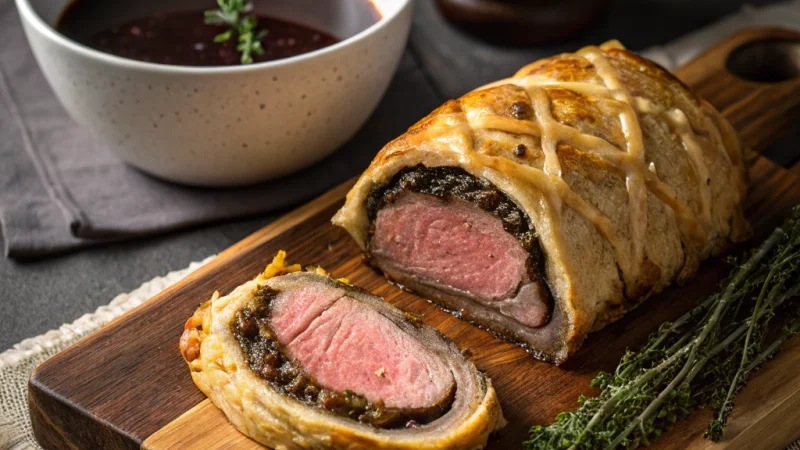
There is a reason the beef Wellington recipe appears on the menu of nearly every fine dining restaurant in Britain and why it remains the undisputed centrepiece dish for Christmas dinners, anniversary celebrations, and any occasion that calls for something genuinely spectacular. It is, quite simply, one of the most impressive things you can cook and bring to a table — a golden, flawlessly crisp pastry log that, when sliced open, reveals a vivid pink beef tenderloin surrounded by a dark, intensely savory layer of mushroom and prosciutto.

The beef Wellington recipe has an intimidating reputation, and not entirely without reason. It requires several steps, a certain amount of planning, and precise temperature control at the oven stage. But it is not technically difficult — it is methodical. Every step in this recipe has a specific purpose, and when each one is executed correctly, the result is virtually guaranteed. Thousands of home cooks make a perfect beef Wellington for the first time every year. This guide will make sure you are one of them.

This is the classic version — beef tenderloin, mushroom duxelles, prosciutto di Parma, all-butter puff pastry — built the traditional way, with every technique explained so you understand not just what to do, but why.

What Is Beef Wellington and Where Does It Come From?

Beef Wellington is a classic British dish consisting of a whole beef tenderloin fillet coated in a paste of finely chopped mushrooms (known as duxelles), wrapped in thin slices of cured ham, and then enclosed entirely in puff pastry before being baked until the pastry is golden and the beef inside is cooked to a perfect pink. The dish is served sliced at the table, revealing its dramatic cross-section.

The dish is named after Arthur Wellesley, the first Duke of Wellington, who defeated Napoleon at the Battle of Waterloo in 1815 and later became British Prime Minister. Whether the Duke himself had any particular fondness for the dish that bears his name is debated — food historians have found no direct connection between the man and the recipe — but the association has stuck for over two centuries, and the name is now inseparable from this preparation in British culinary culture.

Similar preparations exist in French cuisine under the name filet de boeuf en croûte, and the technique of wrapping meat in pastry is ancient. But the British version — with its emphasis on the duxelles layer, the prosciutto barrier, and the all-butter puff pastry — has become the definitive standard and the version that chefs around the world use as their reference point when making this dish.

Why Each Component of a Beef Wellington Recipe Matters

A beef Wellington recipe is not merely a sum of its parts — every layer is there for a reason, and removing or shortchanging any one of them compromises the entire structure of the dish.

The Beef Fillet — Centre-Cut Only

The cut of beef is non-negotiable. A beef Wellington recipe requires the centre-cut of the beef tenderloin — also called the chateaubriand section. This is the thickest, most uniformly cylindrical part of the fillet, which ensures that the entire log cooks at the same rate. If you use a tapered end section, the thinner parts will be well-done before the thicker centre reaches medium-rare. Ask your butcher to trim and tie an 800g centre-cut piece specifically for Wellington — most will do this as a matter of course.

The Duxelles — Dry Is Everything

Duxelles is a French preparation of mushrooms that have been chopped to a near-paste and cooked in butter with shallots and herbs until every last molecule of moisture has been driven out. The mushrooms must be completely dry — paste-like, almost black, and spreadable — before the Wellington is assembled. Wet duxelles is the primary cause of a soggy pastry bottom, which is the most common failure mode of this dish. This step takes 15 to 20 minutes of patient cooking and cannot be rushed.

The Prosciutto — The Moisture Barrier

The thin layer of prosciutto di Parma wrapped around the duxelles-coated beef serves three purposes simultaneously. It acts as a physical moisture barrier between the wet mushroom layer and the pastry. It binds the duxelles to the surface of the beef, preventing it from sliding off during assembly and slicing. And it adds a layer of cured, slightly salty pork flavor that elevates every bite without announcing itself — you would notice its absence more than its presence.

The Dijon Mustard — The Seal

Brushing the seared beef with Dijon mustard before wrapping is one of the most important and most overlooked steps in the entire beef Wellington recipe. The mustard creates a thin, flavored barrier on the surface of the meat that serves as both a moisture seal and an adhesive for the duxelles layer. It also contributes a subtle sharpness that cuts through the richness of the dish without being identifiable as mustard in the finished slice.

The Puff Pastry — All-Butter, Always

The pastry must be all-butter puff pastry — not the vegetable-fat shortcrust variety, not homemade rough puff (unless you are experienced). All-butter puff pastry bakes into distinct, crisp, golden layers with a richness and flavor that mirrors the luxury of the dish. It is widely available in good supermarkets, typically sold as a chilled 500g block. Roll it to an even thickness of approximately 4 to 5mm — too thick and it will be stodgy, too thin and it will tear.

🌟 The 5 Layers of a Perfect Beef Wellington — From Inside Out

1
Beef tenderloin — seared on all sides, cooled, brushed with Dijon mustard
2
Mushroom duxelles — completely dry, deeply dark, seasoned and cooled
3
Prosciutto di Parma — thin slices overlapping into a tight, even sheet
4
All-butter puff pastry — rolled to 4–5mm, sealed with egg wash at all seams
5
Egg wash glaze — applied twice (before and after chilling) for a deep golden crust

Classic Beef Wellington Recipe

Prep45 min
Chill1.5 hr
Cook30 min
Rest10 min
Total~3 hr
Serves6

Ingredients

  • 800 g centre-cut beef tenderloin fillet, trimmed and tied with kitchen twine
  • 2 tablespoons olive oil
  • 2 tablespoons Dijon mustard
  • 500 g chestnut mushrooms, very finely chopped (or pulsed in a food processor)
  • 2 shallots, very finely diced
  • 3 garlic cloves, minced
  • 2 tablespoons unsalted butter
  • 2 tablespoons dry sherry or Madeira wine
  • 1 tablespoon fresh thyme leaves
  • Salt and freshly ground black pepper
  • 10 to 12 thin slices of prosciutto di Parma (about 100 g), at room temperature
  • 500 g all-butter puff pastry, chilled
  • 2 egg yolks + 1 tablespoon whole milk, whisked (egg wash)
  • Flaky sea salt, for finishing

Step-by-Step Instructions

  1. Sear the beef and apply mustard. Remove the beef from the refrigerator 30 minutes before starting. Remove the kitchen twine. Season aggressively on all sides with salt and black pepper. Heat the olive oil in a heavy cast-iron or stainless steel pan over the absolute highest heat until the oil is just beginning to smoke. Sear the fillet for 1 to 2 minutes on each of the four sides and both ends until you have a deep, dark mahogany crust on every surface. Do not move the beef while it sears — let the crust develop. Transfer to a wire rack over a plate and immediately brush every surface generously with Dijon mustard. Leave to cool to room temperature, then refrigerate uncovered for 30 minutes. It must be completely cold before wrapping.
  2. Make the mushroom duxelles. Place the mushrooms in a food processor and pulse until they form a rough paste. Melt the butter in a large, wide pan over medium-high heat. Add the shallots and garlic and cook, stirring, for 2 minutes until softened. Add the mushroom paste, thyme leaves, and sherry. Cook over medium-high heat, stirring frequently, for 15 to 20 minutes. The mushrooms will release a large amount of liquid — keep cooking until every drop has evaporated and the mixture has reduced to a dark, sticky, almost dry paste that holds its shape when pressed. Season generously with salt and pepper. Spread out on a plate or tray and leave to cool completely. Warm or wet duxelles will ruin the pastry.
  3. Wrap in prosciutto and duxelles. Lay a large sheet of plastic wrap (cling film) on a clean work surface. Arrange the prosciutto slices in two slightly overlapping rows to create a rectangle approximately 30 cm wide — wide enough to wrap around the entire fillet with a slight overlap. Spread the completely cooled duxelles in an even, thin layer over the prosciutto, leaving a 2 cm border on the far edge. Remove the cold beef fillet from the refrigerator and place it along the near edge of the prosciutto. Using the plastic wrap to help, roll the prosciutto tightly and evenly around the beef, wrapping the whole parcel in the plastic wrap and twisting the ends firmly to form a tight, uniform log shape. Refrigerate for a minimum of 30 minutes.
  4. Encase in puff pastry. On a lightly floured surface, roll the puff pastry out into a rectangle that is large enough to wrap the beef log with approximately 4 cm of overlap on every side, and approximately 4 to 5 mm thick. Apply egg wash to the pastry edges. Remove the beef from the plastic wrap and place it at the near edge of the pastry. Roll the pastry firmly around the beef, pressing the seam firmly to seal. Tuck and press the ends like a parcel, trimming any excess. Place the Wellington seam-side down on a parchment-lined baking tray. Apply the first coat of egg wash all over the surface. Using the back of a knife, lightly score a criss-cross or diagonal pattern on the top of the pastry (do not cut through). Refrigerate for a minimum of 30 minutes, or overnight.
  5. Bake to a perfect medium-rare. Remove the Wellington from the refrigerator 10 minutes before baking. Preheat the oven to 220°C (425°F / Gas 7). Apply a second coat of egg wash over the entire surface. Sprinkle lightly with flaky sea salt. Place on the middle rack of the oven and bake for 15 minutes at 220°C until the pastry is set and golden. Reduce the oven temperature to 200°C (400°F) and continue baking for a further 10 to 15 minutes. Begin checking the internal temperature with a meat thermometer at the 10-minute mark. Remove the Wellington when the centre reads 52°C to 54°C for medium-rare. If the pastry browns too quickly before the beef is ready, loosely tent with foil.
  6. Rest, carve, and serve. Transfer the Wellington immediately to a carving board. Rest uncovered for a minimum of 10 minutes — this is non-negotiable. The temperature will continue to rise to approximately 57°C and the juices will redistribute through the meat, ensuring every slice is evenly pink and succulent. Using a sharp, long-bladed carving knife, cut the Wellington into slices of 3 to 4 cm thickness using a single, confident pulling motion. Serve immediately.

Internal Temperature Guide for Beef Wellington

A meat thermometer is not optional when making a beef Wellington recipe — it is the only reliable way to know when the beef is perfectly cooked inside the pastry. Timing alone varies too much depending on fillet diameter, oven calibration, and how cold the beef was when it went in. Use a digital instant-read thermometer and check from the side of the Wellington, inserting it into the absolute centre of the fillet.

DonenessRemove from Oven AtFinal Temp After RestingResult
Medium 57°C – 60°C (135°F – 140°F) 63°C (145°F) Light pink, still juicy
Medium-Well 63°C – 65°C (145°F – 150°F) 68°C (155°F) Barely pink, firmer
Well-Done 68°C+ (155°F+) 72°C+ (162°F+) No pink — not recommended for this cut
⚠️ The Three Causes of a Soggy Pastry Bottom — and How to Prevent Every One

A soggy pastry base is the bane of every first-time beef Wellington recipe. It happens for three reasons, and preventing each one is straightforward once you know what causes it. First: wet duxelles — cook the mushroom mixture until it is completely, undeniably dry. Press it with a spatula; no liquid should seep out. Second: an insufficiently cold fillet — the beef must be refrigerated after searing and after each wrapping stage so the fats stay solid and do not leak into the pastry during the early stages of baking. Third: skipping the chilling stage after the pastry is applied — the 30-minute minimum rest in the refrigerator firms the fat in the pastry and sets the shape, ensuring it does not slump or leak during the first minutes in the oven.

💡 Pro Tips for a Showstopping Beef Wellington
  • Buy your beef the day before and leave it uncovered in the refrigerator. Slightly dried-out surface moisture means a better crust when searing and less steam inside the pastry during baking.
  • Use a very hot, dry pan for searing — and do not crowd it. The goal is crust formation, not cooking. The fillet should hiss violently when it hits the pan. If it steams, the pan is not hot enough.
  • Chestnut mushrooms give the deepest flavor for duxelles. You can add 20g of rehydrated dried porcini mushrooms to the fresh chestnut mushrooms for an even more intense, earthy result.
  • Score the pastry top but do not cut through. Scoring allows steam to escape in a controlled way and creates a beautiful visual pattern, but cutting all the way through the pastry lets moisture escape from inside and can cause the Wellington to lose its shape.
  • Apply egg wash twice. Once before refrigerating after wrapping, and once again just before it goes into the oven. Two coats create a significantly deeper, more lacquered golden color than a single application.
  • Always rest before carving. Cutting into the Wellington immediately out of the oven will cause all the juices to run out and the interior temperature to drop rapidly. Ten minutes of resting makes the difference between a perfect slice and a collapsed, grey disappointment.

Popular Variations of the Beef Wellington Recipe

Individual Beef Wellingtons

Instead of one large Wellington for the whole table, individual Wellingtons — each built around a single 150 to 180g beef fillet portion — are easier to serve at a dinner party, allow for greater control over individual doneness, and cook in approximately 15 to 18 minutes total at the same temperatures. The technique is identical but the scale makes each step faster and the final presentation even more elegant, with each guest receiving their own pristine golden parcel.

Mushroom and Spinach Vegetarian Wellington

A wholly plant-based interpretation substitutes the beef with a thick, pressed cylinder of roasted portobello mushrooms and wilted spinach, bound with a mixture of cream cheese, walnuts, and herbs. The prosciutto layer is replaced with thin slices of roasted red pepper, and the rest of the technique — duxelles, puff pastry, egg wash, baking temperature — remains unchanged. When made carefully, this version is genuinely spectacular in its own right and stands entirely on its own as a celebration centrepiece.

Gordon Ramsay Style — With Chicken Liver Pâté

A popular restaurant interpretation, associated strongly with Gordon Ramsay’s version of the dish, adds a thin layer of smooth chicken liver pâté between the mustard-coated beef and the mushroom duxelles. The pâté adds an additional layer of richness and umami that deepens the flavor profile considerably. If using pâté, ensure it is chilled and spread thinly — too much will make the interior wet and the slices unstable.

The Best Sauces to Serve With Beef Wellington

The beef Wellington itself is rich, layered, and deeply savory — the sauce that accompanies it should complement rather than compete. The three most classic and successful pairings are:

  • Red wine jus: The gold standard accompaniment. Made by reducing beef stock with red wine, shallots, thyme, and a knob of butter until glossy and intensely flavored. It mirrors the savory notes of the mushroom duxelles and cuts through the richness of the pastry beautifully.
  • Béarnaise sauce: The French classic of clarified butter emulsified with egg yolks and flavored with tarragon and shallot vinegar. A luxurious, slightly acidic counterpoint to the richness of the beef and pastry. Particularly popular for individual Wellingtons served at restaurants.
  • Horseradish cream: A lighter option of freshly grated horseradish folded into whipped cream with a touch of lemon juice. The heat and sharpness of the horseradish cuts through the fat and brings a brightness that wakes up the palate between bites.
🍴 How to Serve Beef Wellington

Bring the whole Wellington to the table before carving — the moment of the first cut, revealing the vivid pink centre and distinct layers, is part of the drama and pleasure of this dish. Carve at the table using a long, sharp knife, cutting generous 3 to 4 cm slices in a single confident motion. Serve each portion with a drizzle of red wine jus, a selection of roasted vegetables, and either creamy dauphinoise potatoes or buttered new potatoes. Steamed tenderstem broccoli or wilted spinach provides both color contrast and a palate-refreshing green note against the richness of the Wellington.

Nutritional Information (Per Serving)

Values are estimates per slice based on 6 servings using 800g beef fillet, 500g puff pastry, 100g prosciutto, and 500g chestnut mushrooms. Nutritional content of accompaniments and sauce not included.

NutrientPer Serving
Calories620 kcal
Protein42 g
Total Fat38 g
Saturated Fat16 g
Carbohydrates28 g
Dietary Fiber2 g
Sodium740 mg

Make-Ahead, Storage, and Reheating

The entire assembled Wellington — fully wrapped in pastry and egg-washed — can be prepared up to 24 hours in advance and kept in the refrigerator until ready to bake. This is actually the recommended approach for entertaining, as it removes all the stress of same-day assembly. Remove it from the refrigerator 10 to 15 minutes before baking and apply a second coat of egg wash immediately before it goes into the oven.

Leftover cooked Wellington can be stored in the refrigerator for up to 2 days. To reheat, place slices in a 160°C oven for 10 to 12 minutes until warmed through. The pastry will lose some of its crispness but will remain pleasant. Avoid microwaving, which makes the pastry chewy and ruins the texture of the beef. Freezing a fully assembled but unbaked Wellington is possible — wrap tightly in a double layer of cling film and freeze for up to 1 month. Thaw overnight in the refrigerator and bake directly from cold, adding 5 to 8 minutes to the total baking time.

Frequently Asked Questions About Beef Wellington Recipe

Why is my beef Wellington soggy on the bottom?

A soggy bottom comes from excess moisture and has three main causes: duxelles not cooked completely dry, a beef fillet that was not chilled thoroughly before wrapping, or skipping the refrigeration step after applying the pastry. To prevent it, cook the duxelles until it is dark, dry, and paste-like with no liquid. Chill the beef after searing and after each wrapping stage. And always refrigerate the fully assembled Wellington for at least 30 minutes before baking.

What internal temperature should beef Wellington reach?

For a perfect medium-rare — the traditional and recommended doneness — remove the Wellington from the oven when the internal temperature reads 52°C to 54°C (125°F to 130°F). The temperature will continue to rise during the 10-minute resting period to approximately 57°C (135°F). Always use a digital meat thermometer inserted into the very centre of the fillet for an accurate reading.

Can beef Wellington be prepared the day before?

Yes — and it is strongly recommended. Fully assemble the Wellington, wrap it tightly in puff pastry, apply the first coat of egg wash, and refrigerate overnight. The cold rest firms up the pastry and helps everything hold its shape perfectly during baking. Take it out of the refrigerator 10 minutes before baking and apply a second egg wash coat just before it goes in the oven.

What cut of beef is used in a beef Wellington recipe?

Beef Wellington requires a centre-cut beef tenderloin fillet — the thickest, most uniform section of the whole tenderloin. Its cylindrical shape ensures even cooking throughout the log. Avoid the tapered ends of the tenderloin, as the thinner sections will overcook before the thicker centre reaches the correct temperature. Ask your butcher specifically for a centre-cut piece trimmed and ready for Wellington.

Why do you wrap beef Wellington in prosciutto?

The prosciutto layer serves three purposes: it acts as a moisture barrier between the duxelles and the pastry, it binds the mushroom layer to the beef to prevent it sliding during assembly and carving, and it adds a subtle layer of cured, salty pork flavor. It is both a structural and a flavor component of the dish and should not be omitted.

How do I stop the pastry from burning before the beef is cooked?

If the pastry is browning too quickly before the beef reaches the target internal temperature, loosely tent a sheet of aluminium foil over the Wellington for the remaining baking time. This slows the browning of the pastry while allowing the oven heat to continue cooking the beef inside. Starting at 220°C and reducing to 200°C after the first 15 minutes — as this recipe instructs — also manages browning effectively.